


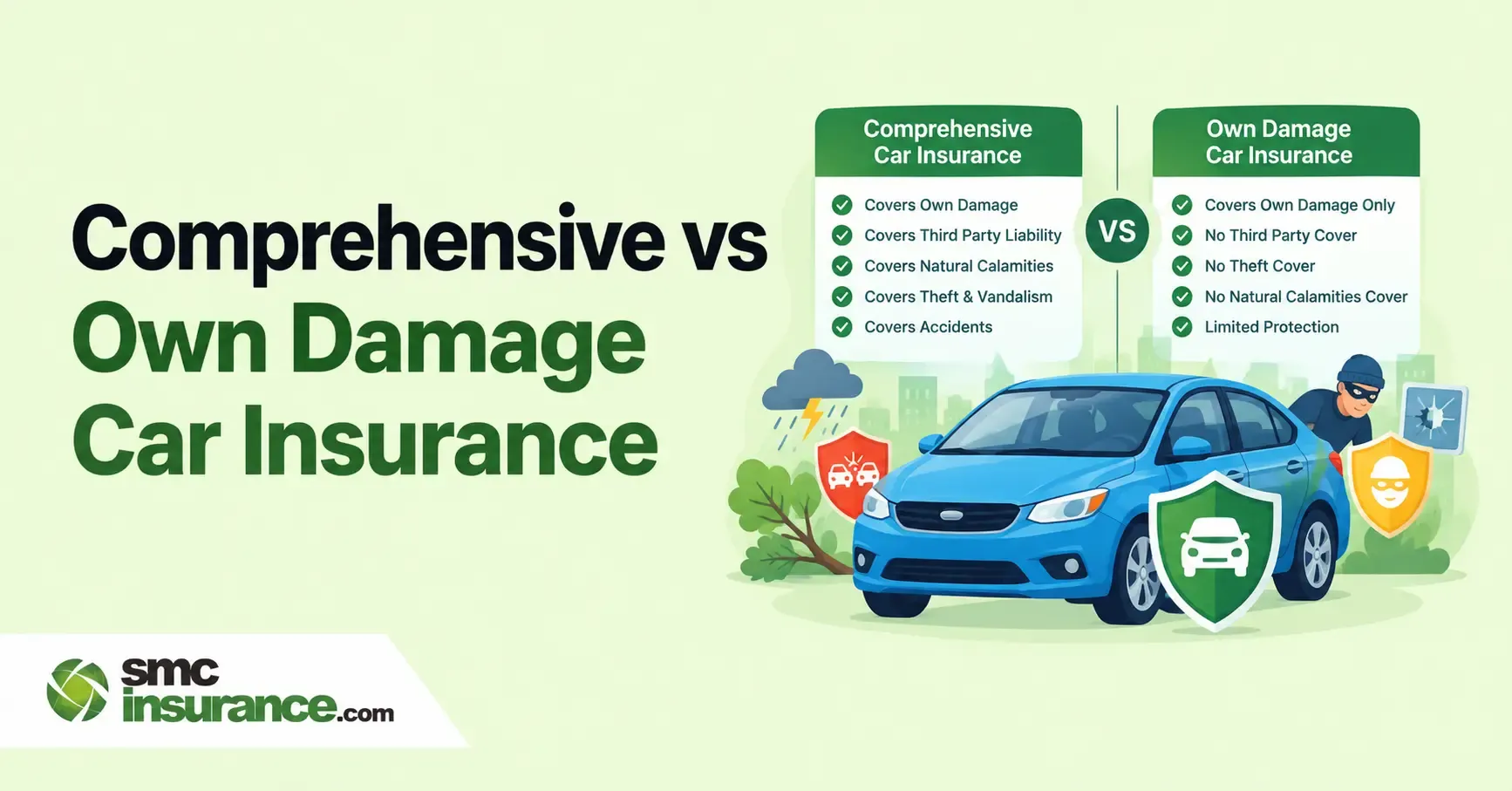
Own damage (OD) cover protects your car against covered losses such as accidents, theft, fire and natural calamities, but it does not provide third-party liability protection. A standalone OD policy can be issued when valid third-party cover is already in force or is being purchased simultaneously. Comprehensive or package cover combines own-damage and third-party protection, while the owner-driver's compulsory personal accident cover is governed separately under the motor insurance framework. For a new private car, the usual bundled structure provides one year of OD cover with three years of third-party cover. After the first year, you can renew the OD portion separately while the long-term TP cover remains active.
Table of Contents
- What Is Own Damage (OD) Car Insurance?
- What Is Comprehensive Car Insurance?
- Own Damage vs Comprehensive: The Real Differences
- Why You Can Buy OD Separately: The IRDAI Backstory
- New-Car Insurance: 3-Year TP Does Not Mean 3-Year OD
- How Depreciation Eats Into Your Claim
- No Claim Bonus
- Own Damage or Comprehensive: How to Actually Decide
- Step-by-Step: Switching From OD-Only to Comprehensive
Your third-party cover is sitting in the glovebox, valid and legal and you still cannot stop thinking about the dent a stray cricket ball put in your bonnet last monsoon. That is the moment most car owners in India realise third-party insurance was never designed to fix their own car. It only pays for the other person's loss. So the real decision on your desk is comprehensive vs own damage car insurance and getting it wrong means either overpaying for cover you do not need or discovering, mid-claim, that a policy you assumed was complete never touched your own vehicle at all. By the end of this piece, you will know exactly which of the two fits your car, your budget and how you actually drive.
What Is Own Damage (OD) Car Insurance?
Own damage cover, usually just called OD, pays for repairs to your own car after an accident, fire, theft, or a natural event like flooding or a fallen tree. It says nothing about the other vehicle or the other person's property. That part is handled separately, by your third-party liability policy, which is compulsory under the Motor Vehicles Act regardless of what else you buy.
A standalone own damage policy is not designed to replace third-party insurance. IRDAI's motor insurance framework requires the vehicle to have valid third-party cover already in force or to have third-party cover taken simultaneously when standalone OD is issued. In practice this means an OD-only plan suits someone who already has an active third-party policy running, typically a new car owner in year two or three of ownership, once the long-term third-party cover bought at purchase is still valid but the bundled own damage cover has expired.
This structure is particularly relevant to owners of new private cars sold with the long-term third-party cover introduced from 1 September 2018. Their three-year TP cover can remain active after the one-year OD component of a bundled policy expires, allowing them to renew the OD portion separately.
What Is Comprehensive Car Insurance?
Comprehensive or package car insurance combines protection for your own vehicle with third-party liability cover. For a new private car, this may be structured as a bundled policy with three years of third-party cover and one year of own-damage cover. The OD portion can then be renewed annually while the long-term TP cover continues until its expiry. For other vehicles and renewal situations, policy duration depends on the product selected.
Most insurers let you stack add-ons on top of a comprehensive base, things like zero depreciation cover, engine protection, or roadside assistance, none of which are available on a plain third-party policy. The owner-driver is also subject to the applicable compulsory personal accident cover requirements. The regulatory framework provides for a minimum capital sum insured of Rs. 15 lakh, subject to the policy structure and eligibility conditions. The cover should not be treated as an exclusive feature of comprehensive insurance, and customers who already have qualifying owner-driver PA cover may not need duplicate cover. That single clause is often the deciding factor for families who want the driver covered, not just the car.
Own Damage vs Comprehensive: The Real Differences
The table below lays out where the two actually diverge, not just the headline coverage but the practical stuff that shows up at claim time.
Basis |
Standalone OD Cover |
Comprehensive / Package Cover |
Premium | Covers the OD component. TP premium is paid separately where required | Includes OD and third-party components, so the combined premium is generally higher than OD alone |
Third-party liability | Not included | Included |
Owner-driver PA | Subject to applicable PA requirements and existing qualifying cover | Subject to applicable PA requirements |
Add-ons | Availability varies by insurer and product | Availability varies by insurer and product |
Typical use case | Useful when valid long-term TP cover is already in force | Useful when the customer wants OD and TP protection under the same insurance arrangement |
Note: Premiums vary by insurer, car model, engine capacity, city and the Insured Declared Value (IDV) you choose, so treat this as a structural comparison rather than a price quote. Always check the latest premium on the insurer's own portal before renewing.
There is a neat segue here worth pausing on. The coverage difference explains what each policy pays for, but the regulatory backdrop explains why you are even being offered a choice in the first place.
Why You Can Buy OD Separately: The IRDAI Backstory
This flexibility is fairly recent and knowing the timeline helps you understand what your renewal notice is actually asking you to do.
In 2018, the Supreme Court directed insurers to sell only long-term third-party covers with new vehicles, three years for cars and five years for two-wheelers, to cut down on the number of vehicles running around uninsured after their first-year policy lapsed. That part of your cover is locked in for the full term and does not need annual renewal.
Then, through a circular dated 21 June 2019, IRDAI asked insurers to start offering standalone own damage policies from September 2019 onward, so that once the bundled one-year OD cover on a new car expired, owners were not forced to renew it with the same insurer at whatever price was quoted. This is what created genuine price competition on the OD side.
A further change followed in 2020. From 1 August that year, IRDAI withdrew the option of buying a long-term bundled OD-plus-TP package. So today, a new car typically leaves the showroom with a three-year third-party policy and a one-year own damage cover and from year two onward, you renew the OD portion annually, either with your original insurer or a different one entirely.
Practically, this is where the comprehensive vs own damage car insurance decision resurfaces every single year at renewal, not just once at the time of purchase.
New-Car Insurance: 3-Year TP Does Not Mean 3-Year OD
A common source of confusion is assuming that the three-year insurance sold with a new private car means the own-damage cover also lasts for three years. Under the current structure, a new private car can have a bundled policy with three years of third-party liability cover and one year of own-damage cover.
That means the OD component can come up for renewal after the first year even though the third-party cover remains active. At that point, the owner can compare standalone OD options from insurers instead of buying another third-party policy for the same period.
The distinction matters because the premium, IDV, deductibles, NCB and add-ons you compare at the first OD renewal relate primarily to the own-damage component, while the existing long-term TP cover continues separately.
How Depreciation Eats Into Your Claim
This is the part most owners never check until a claim payout comes in lower than expected and it applies equally whether you are running a standalone OD policy or the OD half of a comprehensive one.
When you file a claim, the insurer does not pay the full replacement cost of every part. Rubber, nylon and plastic components, tyres, tubes and batteries are depreciated at a flat 50%, fibreglass parts at 30% and glass parts carry no depreciation at all. Everything else follows a schedule tied to the age of the vehicle.
Age of Vehicle |
Depreciation on Metal and Other Parts |
Up to 6 months | Nil |
6 months to 1 year | 5% |
1 to 2 years | 10% |
2 to 3 years | 15% |
3 to 4 years | 25% |
4 to 5 years | 35% |
5 to 10 years | 40% |
Over 10 years | 50% |
Note: These are the standard IRDAI-aligned depreciation rates used across insurers for claim settlement on parts replaced. A zero depreciation add-on, where available, waives most of this deduction, but it usually cannot be added once your car crosses a certain age, often five years, so it needs to be chosen at the right renewal, not after a claim has already been filed.
Note that depreciation used for claim settlement on replaced parts is different from the age-based depreciation used to calculate the vehicle's IDV. The applicable calculation depends on whether the claim involves partial loss or total loss/theft.
Our advisors flag this every renewal season, because the gap between what a customer expects and what actually lands in their account after a bumper or headlight claim is almost always this depreciation table, not the policy terms.
No Claim Bonus
No Claim Bonus, or NCB, is a discount applied to the own damage premium alone,
never to the third-party portion and it rewards every consecutive year you go without filing an OD claim. It starts at 20% after your
first claim-free year and climbs in steps to 25%, 35%, 45%, before capping at 50% from the fifth claim-free year onward.
File even one own damage claim and the NCB resets to zero the following year, regardless of how many years you had banked before that. This is precisely why it often makes sense to pay a small repair bill out of pocket rather than claim it, if the repair cost is close to what you would lose in NCB the following year. NCB also travels with you, not the car, so it transfers to a new vehicle or a new insurer as long as
you claim it within the window your previous insurer allows.
Want a policy that gets this pricing right the first time instead of you working it out after the bill arrives? Compare comprehensive and own damage car insurance options with SMC Insurance and let our advisors match the cover to how you actually drive.
Want a policy that gets this pricing right the first time instead of you working it out after the bill arrives? Compare comprehensive and own damage car insurance options with SMC Insurance and let our advisors match the cover to how you actually drive.
Own Damage or Comprehensive: How to Actually Decide
Skip the generic advice and run through this instead:
- If your car is brand new, check whether your policy is structured as a bundled policy with three years of third-party cover and one year of own-damage cover. Compare the OD component, IDV, deductibles and available add-ons before renewal.
- If your long-term third-party cover is still active, you can consider standalone OD when the annual OD component expires. Compare quotes across insurers rather than assuming you need to renew OD with the original insurer.
- If your car is older, compare the OD premium with the vehicle's current IDV, deductibles, depreciation rules and likely repair costs before deciding how much own-damage protection you want.
- If you need features such as roadside assistance, engine protection or zero depreciation, check whether the required add-on is available with the specific standalone OD or comprehensive product you are considering. Add-on availability and conditions vary by insurer.
Step-by-Step: Switching From OD-Only to Comprehensive
If you currently hold a standalone own damage policy and want to move to comprehensive cover, here is the straightforward path.
- Check the expiry dates of your existing OD and third-party policies.
- Compare comprehensive/package options, including IDV, deductibles, NCB and add-ons.
- Keep your RC, existing policy details and NCB information ready.
- If the insurer requires inspection because of a break in OD coverage, complete the inspection before policy issuance.
- Confirm that the new policy is active and that the third-party cover remains valid. If you are replacing an existing TP policy, follow the insurer's process for cancellation, transfer or adjustment rather than allowing mandatory TP cover to lapse.
Wrapping Up
Own damage cover repairs your car. Comprehensive cover repairs your car and settles your legal liability to anyone else affected by an accident you cause. Own damage cover protects your vehicle against covered losses, while comprehensive or package cover combines own-damage protection with third-party liability. For a new private car, the insurance structure generally provides three years of third-party cover and one year of own-damage cover under a bundled policy. Once the annual OD component expires, you can compare standalone OD options while the long-term TP cover remains active. The right choice depends on factors such as your vehicle's age, IDV, existing TP cover, premium, deductibles, add-on requirements and lender conditions, where applicable. What matters is picking the one that matches where your car actually is in its ownership cycle, not just what the renewal SMS happens to nudge you toward.
Disclaimer: The information provided on this platform is intended for general awareness and educational purposes. While every effort is made to ensure accuracy, some details may change with policy updates, regulatory revisions, or insurer-specific modifications. Readers should verify current terms and conditions directly with relevant insurers or through professional consultation before making any decision.
All views and analyses presented are based on publicly available data, internal research and other sources considered reliable at the time of writing. These do not constitute professional advice, recommendations, or guarantees of any product’s performance. Readers are encouraged to assess the information independently and seek qualified guidance suited to their individual requirements. Customers are advised to review official sales brochures, policy documents and disclosures before proceeding with any purchase or commitment.
FAQs
No, only third-party liability insurance is legally mandatory under the Motor Vehicles Act. Own damage cover is optional, though strongly recommended, since it is the only part of your policy that pays for repairs to your own vehicle.
No, not from a completely blank slate. IRDAI rules require that you already hold, or are simultaneously buying, a valid third-party liability policy before an insurer will issue you a standalone own damage policy.
Yes, in absolute premium terms, because it includes the third-party liability premium on top of the own damage premium. Whether it works out costlier overall depends on whether you would otherwise be paying for TP and OD separately anyway.
No, your NCB is tied to your claim history, not the type of policy you hold. As long as you carry over your NCB certificate correctly when switching, the discount percentage stays intact.
Depreciation on parts increases sharply with vehicle age, reaching 40% between five and ten years and 50% beyond that. For an old car, it is worth calculating whether the claim payout after depreciation is even worth filing, compared to the NCB you would lose.
Yes, most insurers allow it on standalone OD policies the same way they do on comprehensive ones, though the add-on is usually restricted once the car crosses a certain age, commonly around five years.
Most lenders insist on comprehensive cover for financed vehicles, since it protects both the vehicle's value and the third-party liability exposure while the loan is outstanding. Check your loan agreement before opting for a standalone OD policy.


